Logo screenshot (JPEG quality 70)

7.0 KB

134 paths · 31.9 KB
Illustration style, default settings
Flat shapes and lettering trace cleanly. The SVG is larger than the JPG because every letter and edge becomes path data.
Drop a JPG or JPEG and get an SVG built from real vector paths, traced right in your browser. The converter does not upload your file, and there is no signup.
PNG, JPG, WebP, BMP, or GIF. Your file stays in this browser.
A JPG is a grid of pixels. To convert JPG to SVG, the converter groups similar colors into flat regions and traces the outline of each region as a vector <path>. The result scales to any size without blurring, and every shape can be selected and edited in Illustrator, Figma, Inkscape or a text editor.
Every JPG is traced three ways at once — Illustration, Clean and Compact — so you can compare them side by side and download the one that fits. Illustration and Clean use imagetracerjs; Compact uses vtracer compiled to WebAssembly. All three run on your device. JPG and JPEG are the same format, so this one JPG to SVG page covers both .jpg and .jpeg files.
Measured on 2026-11-20 by running the real converter (a local production build in headless Chromium) on three test JPGs we made for this page: a logo screenshot, a scanned hand drawing and a photo-style landscape, each 480 × 320 px. Sizes are in KB (1 KB = 1,024 bytes).
Illustration style, default settings
Flat shapes and lettering trace cleanly. The SVG is larger than the JPG because every letter and edge becomes path data.
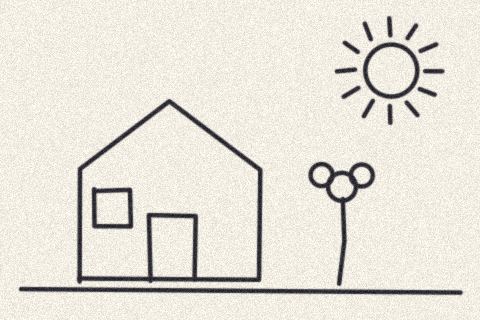
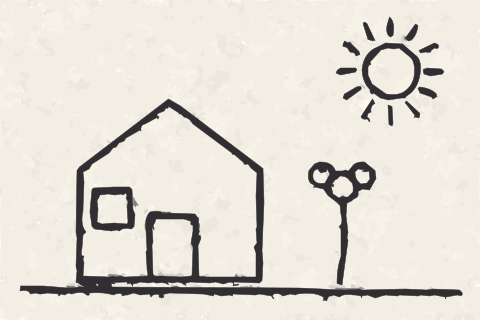
Illustration style, Denoising Strength: Strong
Ink lines become solid vector shapes. Paper grain still leaves small specks; Denoising Strength: Strong removes many of them.
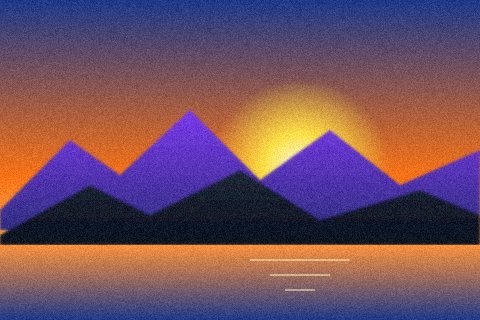
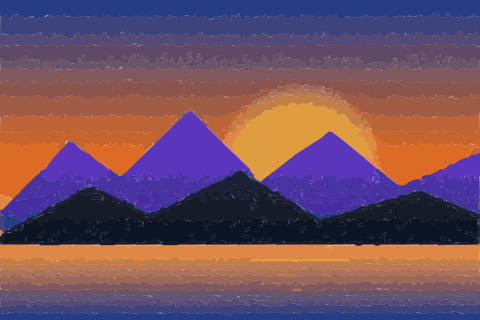
Clean style, default settings
Smooth gradients are posterized into bands of flat color. It is a real vector, but it will not look like the photo, and the file is several times larger than the JPG.
Each conversion produces all three styles. Default = built-in settings (Denoising Strength: Weak, 24 colors, 640 px processing size). Strong = the same with Denoising Strength set to Strong. Every output contained <path> elements and none contained an <image> element.
| JPG input | Style | Default | Strong |
|---|---|---|---|
| Logo screenshot (JPEG quality 70) (7.0 KB) | Illustration | 134 paths · 31.9 KB | 59 paths · 15.9 KB |
| Logo screenshot (JPEG quality 70) (7.0 KB) | Clean | 186 paths · 43.4 KB | 68 paths · 18.9 KB |
| Logo screenshot (JPEG quality 70) (7.0 KB) | Compact | 180 paths · 58.0 KB | 48 paths · 30.8 KB |
| Hand-drawn sketch on paper (30.8 KB) | Illustration | 1,758 paths · 502.8 KB | 639 paths · 189.5 KB |
| Hand-drawn sketch on paper (30.8 KB) | Clean | 2,119 paths · 563.5 KB | 772 paths · 210.8 KB |
| Hand-drawn sketch on paper (30.8 KB) | Compact | 1,811 paths · 749.7 KB | 370 paths · 434.2 KB |
| Photo-style landscape (35.6 KB) | Illustration | 135 paths · 115.5 KB | 52 paths · 75.4 KB |
| Photo-style landscape (35.6 KB) | Clean | 203 paths · 171.8 KB | 67 paths · 110.2 KB |
| Photo-style landscape (35.6 KB) | Compact | 824 paths · 435.6 KB | 150 paths · 278.9 KB |
An .svg file is not automatically a vector. A converter can also take the original JPG, encode it as base64 and place it inside an SVG as an <image> element. The file ends in .svg, but it is still pixels: it blurs when scaled up, cannot be recolored shape by shape, and gives cutting machines and plotters no outlines to follow.
This converter traces instead. Its output is made of <path> elements with solid fills. In our 2026-11-20 test every output contained paths and none contained an <image> element or a data:image URL. You can check any SVG yourself: open it in a text editor and search for "<image".
<svg xmlns="http://www.w3.org/2000/svg" viewBox="0 0 480 320">
  <path fill="rgb(29,78,217)" d="M 96.5 96 L 165.5 96 …" />
  <path fill="rgb(19,25,41)" d="M 216.5 134 L 240.5 134 …" />
  <!-- 134 paths in total -->
</svg><svg xmlns="http://www.w3.org/2000/svg" viewBox="0 0 480 320">
<image width="480" height="320"
href="data:image/jpeg;base64,/9j/4AAQSkZJRgABAQ…" />
</svg>These are the settings that exist in the converter's Adjust Settings panel. Change them and choose Apply & Re-generate. Save as Default stores them in this browser for next time.
| Setting | Options | Default | What it does |
|---|---|---|---|
| Output style | Illustration, Clean, Compact | All three are generated | Illustration: flat color layers with the dark lines merged into one line-art layer. Clean: median-filtered, color-quantized trace for a softer result. Compact: vtracer (WebAssembly) layers, usually the fewest paths for logos and icons. |
| Denoising Strength | Strong, Medium, Weak | Weak | Higher strength drops more small specks and simplifies curves. Strong is the setting that helps most with JPEG noise and paper grain; Weak keeps the most detail. |
| Colors | 2 to 24 | 24 | The maximum number of flat colors in the palette. Fewer colors mean fewer, larger regions and usually a smaller SVG. |
| Processing size | 256 to 1200 px, in steps of 64 | 640 px | The JPG is scaled down so its longest side fits this size before tracing; smaller images are not enlarged. Larger values keep more detail but produce more paths and take longer. |
| Transparent solid background | On, Off | Off | Removes a flat background color that touches the edges of the image. See the next section for exactly how it decides. |
| Your JPG | Try | Why |
|---|---|---|
| Logo, icon or UI screenshot | Compact or Illustration; Denoising Strength: Strong; lower Colors to about the number of colors in the logo | JPEG compression adds off-color pixels along edges. Strong and a smaller palette stop those from becoming extra paths. |
| Scanned drawing, sketch or signature | Illustration or Compact; Denoising Strength: Strong | Paper grain is traced as specks at Weak. In our test Strong produced far fewer paths (see the measurements above). |
| Photo | Clean; Denoising Strength: Strong; fewer Colors for a bolder poster look | Photos always posterize. Strong and fewer colors give larger flat areas and a smaller file; more colors give smoother bands but a bigger file. |
When the switch is on, the converter reads the four corner pixels. If all four are opaque and the same color (within ±2 on each RGB channel), every pixel of that color connected to the image edge is treated as background and left out of the SVG. Areas of the same color enclosed inside the artwork are kept.
JPG has no alpha channel, so this switch is the only way to get a transparent background from a JPG. It works best on screenshots and exports with a perfectly flat background. On scans and photos the corners rarely match exactly, so nothing is removed: in our test the switch changed nothing on the hand-drawn sketch or the landscape.
JPEG compression also leaves slightly off-color pixels around edges. Those fall outside the ±2 tolerance and can remain as a faint halo of small shapes. On our logo screenshot (Illustration style) the path count went from 134 to 281 with the switch on; adding Denoising Strength: Strong brought it down to 103.
JPG saves space by throwing away detail in 8 × 8 pixel blocks. That leaves blocky patches in flat areas, ringing (faint ripples) next to sharp edges, and color bleeding around text, because color is usually stored at a lower resolution than brightness.
A tracer cannot tell those artifacts from real detail. Each slightly different shade can become its own small shape, which is why a noisy JPG produces more paths and a bigger SVG than a clean copy of the same picture. In our test, the logo screenshot saved at JPEG quality 70 needed 134 paths in Illustration style; a lossless WebP copy of the same logo needed 28.
What helps: start from the highest-quality JPG you have, raise Denoising Strength, lower Colors, and if you still have the original artwork as a PNG or as a lossless file, convert that instead.
Three steps, all in your browser.
Drag a .jpg or .jpeg file onto the page, click Upload your image, or paste an image from the clipboard.
Illustration, Clean and Compact are traced automatically. If the result is noisy, open Adjust Settings, raise Denoising Strength or lower Colors, and choose Apply & Re-generate.
Click Download SVG under the style you like, or Copy SVG to paste the markup into your code or design tool.
Real tracing. The output is made of vector <path> shapes with solid fills. It does not embed the JPG as an <image>; in our tests no output contained an <image> element or a data:image URL.
No. The converter decodes and traces the JPG in your browser, and the file is not uploaded by the converter flow. No account is needed.
Yes. JPG and JPEG are the same format with different file extensions. The converter also accepts PNG, WebP, BMP and GIF.
JPG is a compressed pixel format; an SVG stores every shape as text coordinates. Detailed or noisy images need many paths. Raise Denoising Strength, lower Colors or lower Processing size to get a smaller file.
Yes, if the background is a flat color touching the image edges: turn on Transparent solid background in Adjust Settings. It will not remove textured or gradient backgrounds, such as paper or sky in a photo.
No. Tracing turns a photo into flat color regions, like a poster. It works best for logos, icons, line art, scans and simple illustrations.